

Hinterer Seelenkogel
Map & elevation profile
The Tour
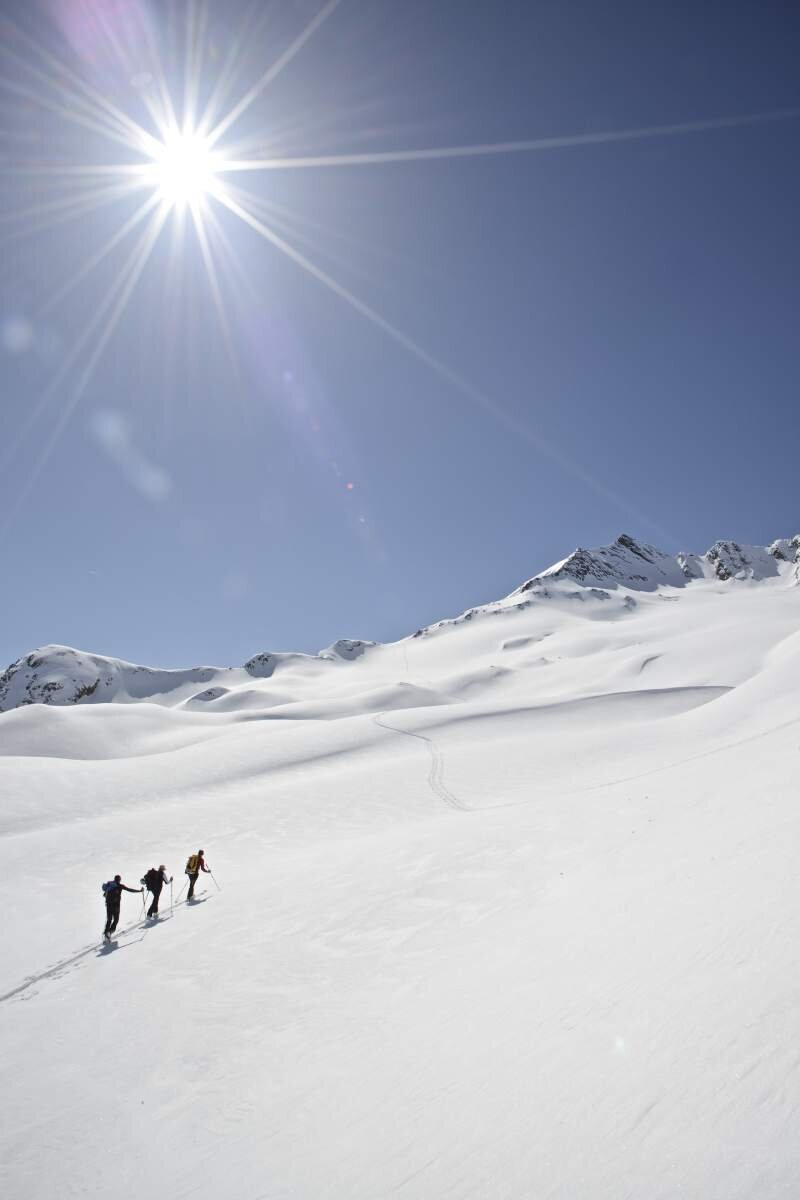
From the Langtalereckhütte somewhat steeper upwards towards east-southeast towards Eiskögele, up to an altitude of about 2,700 m. Upwards over a nicely tiered glacier terrain. At the end over a short steep section to the summit structure, then on foot to the summit. Descent into the Langtal back to the hut.
Regions & Places
Mountain areas
Details
Characteristics
Way types
Exposition
Safety guidelines
Avalanche danger scale
1 (LOW)
An avalanche release is only possible with great additional load on very few, extreme steep slopes. No spontaneous avalanches (so-called slides) are to be expected. Generally safe conditions.
2 (MODERATE)
An avalanche release is likely with great additional load especially on the indicated steep slopes. Larger avalanches are not expected. The snow cover is generally well consolidated, except on some steep slopes. Cautious route selection on the indicated steep slopes and aspects.
3 (CONSIDERABLE)
An avalanche release is likely even with slight additional load, especially on the indicated steep slopes. Occasionally some medium, rarely also large avalanches are possible spontaneously. The snow cover is only moderately to weakly consolidated on many steep slopes. Experience in avalanche assessment is necessary. Avoid the specified steep slopes and aspects as much as possible.
4 (HIGH)
An avalanche release is possible already with slight additional load, especially on the indicated steep slopes. Many medium and also several large avalanches may occur. The snow cover is only weakly consolidated on many steep slopes. Route selection should be restricted to moderately steep terrain and attention to avalanche runout zones. Much experience in avalanche assessment is required.
5 (VERY HIGH)
Numerous large avalanches, even in moderately steep terrain, are to be expected spontaneously. Under this warning level, safe operation in ski areas is no longer possible. The snow cover is generally weakly consolidated and unstable. Avoid tours is recommended.
See also under
Additional information
Ski touring rules
- Observe the applicable regulations in nature and when choosing the route (e.g., wildlife protection areas, hunting restricted areas, reforestation areas, information boards, etc.)
- Respect quiet zones for wildlife and avoid feeding stations and loud noises
- In winter, cross forest areas only on designated paths and routes; animals react very panicky to untraceable noise.
- Recognize the habitats of wildlife, avoid animals when possible. Observe wildlife only from a distance. Dogs must be kept on a leash; it is absolutely irresponsible to let dogs run free in the forest during critical winter periods.
- Proper timing: Start early enough and return before nightfall. In spring, you should be back at the hut by noon (avalanche danger)
- Never ski through reforestation and young tree growth areas.
Ötztal Tourism assumes no liability for the listed tours and recommends taking a mountain guide. Glacier crossings are only possible with a rope and in a group.
Before setting off, inform someone in the valley about your destination and expected return time. Carrying an avalanche beacon is strongly recommended.
More information about ski touring in the Ötztal: https://www.oetztal.com/skitouren
Directions
From the Langtalereckhütte somewhat steeper upwards towards east-southeast towards Eiskögele, up to an altitude of about 2,700 m. Upwards over a nicely tiered glacier terrain. At the end over a short steep section to the summit structure, then on foot to the summit. Descent into the Langtal back to the hut.
Arrival
Public transit
Travel comfortably and safely by train to the Ötztal train station. The terminus or exit point is the ÖTZTAL station. Afterwards, you can travel conveniently and quickly with public buses or local taxi companies through the entire valley to your desired destination! The current bus schedule is available at: http://fahrplan.vvt.at
Starting point
Getting there
Obergurgl is located in western Austria in the state of TIROL, in a southern side valley of the Inn valley - the ÖTZTAL. For your arrival by car, plan the optimal travel route from your hometown using the route planner online: https://www.google.at/maps
Parking
The following parking options are available in Obergurgl-Hochgurgl:
- Parking lot village center Obergurgl (right down in front of the church, behind the multipurpose building where the information office is also located) parking meter with coin slot
- Parking lot village entrance – valley station Festkoglbahn, free of charge – no overnight parking
- Parking lot Hochgurglbahn valley station, free of charge – no overnight parking
- Parking lot Top Mountain Crosspoint, free of charge
- Parking lot Hochgurgl, free of charge (very small parking lot)
Current information
The tour is within these protected areas.
Equipment
Recommended ski touring equipment
The "normal ski touring equipment" consists of touring skis with touring bindings, telescopic poles, climbing skins, crampons, a digital avalanche beacon, avalanche shovel, avalanche probe, first aid kit, and a mobile phone. A "complete glacier equipment" consists of a harness, two prusik loops or ascenders of different lengths, two HMS carabiners, an ice axe, crampons, and a rope. A backpack with appropriate contents should be carried, including spare clothing, sun protection, cold protection, food, and enough to drink! For hut overnight stays, do not forget to bring hygiene articles and a hut sleeping bag!
Difficulty rating
- Easy: Easy, short to moderately long tours with ascents that do not or only briefly exceed 25°.
- Medium: Medium-difficulty, moderately long to long tours with ascents that do not or only briefly exceed 35°.
- Hard: Difficult, long to very long tours with ascents that reach 40° or more and climbing sections up to grade II difficulty (UIAA).